

Table of Contents
Introduction:
Attention:
When sitting up or straining do you feel a bulge in your abdomen? The ridge that was seen might have been Diastasis Recti exercises recti. It is not rare, in fact, it becomes more common following the birth or after a major change of weight.
Interest:
The Diastasis Recti exercises results when the abdominal muscles become distended mid between. This alienation undermines your heart. It can lead to poor posture, low stability and back pain. The good news? The specific exercises on diastasis recti could assist in regaining the strength in a safe manner.
Desire:
You do not have to undergo drastic activities. You require the research-backed motions that are in control. When properly performed, the exercises can restore the central functioning, enhance the alignment and decrease abdominal swellings.
Action:
This guide will teach you about the definition of diastasis recti, the activities that are the most effective, the ones that should be avoided and how to develop a safe recovery program. We will rebrand your core in a smart way.

What Is Diastasis Recti?
Diastasis Recti exercises is the name of the process of separating the muscles of the retus abdominis. These are the six pack muscles that are found straight up on your belly.In between these muscles is the linea alba which is a type of connective tissue. During the process of stretching and thinning, the muscles are decoupled. This creates a dissimilarity that appears or becomes sensual.The disorder is normally common in women who are in the postpartum period. However, it may also be developed by men and newborns themselves. It may be added by a sudden increase in weight, lifting in an unsuitable way or severe abdominal tension.
You may notice:
• In the center of your stomach, a bump.
• Lower back pain
• Weak core strength
• Poor posture
• Pelvic floor dysfunction
The first step is to understand the problem. And now we shall turn to the way diastasis recti exercises would help.

The Rationale of Diastasis Recti Exercises
What you have on the inside is better than your abs. It consists of transverse abdominis, pelvic floor, diaphragm and deep stabilizing muscles.In case of abdominal separation, the deep core muscles become inefficient. This influences the breathing mechanism and stability of the spine.Supported by the pelvis- and body-floor-work-spread, the diastasis recti exercises should be performed with the penalty of the pelvis against the body floor.<|human|>With the pillar-up-lit-by-the-pelvis-and-body-floor-work-spread, the exercises of the Diastasis Recti exercises are to be practised with the penalty of the pelvis upon the body floor.
Activation of transverse abdominis.
• Enhance the practice of intra-abdominal pressure control.
• Support spinal alignment
• Reduce abdominal doming
• Increase coordination of the pelvis floor.
Symptoms can become worse, should you disregard the problem. Weakness may result in hernia or chronic back pains. This is the reason that it is necessary to have a structured, progressive plan.
How to Diastasis Recti Diagnosis
Determine your state of health before Diastasis Recti exercises. An idea of severity can be provided by a self-check.
Self-Assessment Steps
1.Sit up in position and bend the knees.
2. With one hand put behind your head.
3. Raise your head in little, such a mini-crunch.
4. Run your fingers along your midline that is just above and below your belly button.
In case you feel a gap of more than two finger-widths there may be diastasis recti.
To have an accurate Diastasis Recti exercises, a physical therapist must be consulted. Professional evaluation is the guarantee of the safe development of exercising.

Best Diastasis Recti Exercises to Strengthen the Core
These are Diastasis Recti exercises that are directed to the deep core. Perform them slowly. Control your breathing. It is a question of quality rather than degree of intensity.
1. Diaphragmatic Breathing
Diastasis recti exercises all depend on this.With one hand on your breast and the other on your belly lie down on your back. Inhale through your nose. Dilate your ribs, and not your chest. Breath in slowly and pull your stomach in slowly.Practice for 5–10 minutes daily. Deep stabilizers and your body pre-moving are done by controlled breathing.
________________________________________
2. Activation of Transverse Abdominis (Abdominal Bracing)
This workout works your innermost abdominal layer.Bend your knees lying on your back. Inhale. You are also breathing out, and you are drawing your lower belly towards your back without tilting your pelvis.Breath normally hold 5-10 seconds. Repeat 10 times.Avoid sucking in forcefully. Imagine putting a belt round your waist which is large.
________________________________________
3. Pelvic Tilts
Pelvic tilts enhance the coordination between the lower back and the abs.\Lie on your back. Lift your buttocks up against the floor by tilting the pelvis upwards. Tighten your stomach during the breathing out.Hold for 5 seconds. Relax slowly.Repeat 10–15 times. This exercise is beneficent in abdominal deep muscles.
________________________________________
4. Heel Slides
The core stability is tested with the heel slides.Bend your knees lying on your back. Engage your core. Slide one heel slowly forward and your leg is almost straight.Keep your abdomen flat. Do not allow bulging.Please, turn back and change sides. Perform 10 reps per side.
________________________________________
5. Modified Side Plank
Planks on the sides are good Diastasis Recti exercises that build oblique but do not strain the center.Bend on your side on knees. Lean on yourself on the forearm. Raise up hips and maintain the body straight.Hold for 10–20 seconds. Breathe steadily.Repeat on both sides
When Ready: Advanced Diastasis Recti Exercises
As soon as you have bridged your divide and can control your core, you are good to go.
There should be constant attention to abdominal doming. When you observe bulging, hold back the exercise.
Bird Dog
Start on hands and knees. Engage your core. Recluse one arm and the other leg.Keep your hips level. Hold for 5 seconds. Alternate sides.This enhances spinal stability and deep core stability.
_______________________________________
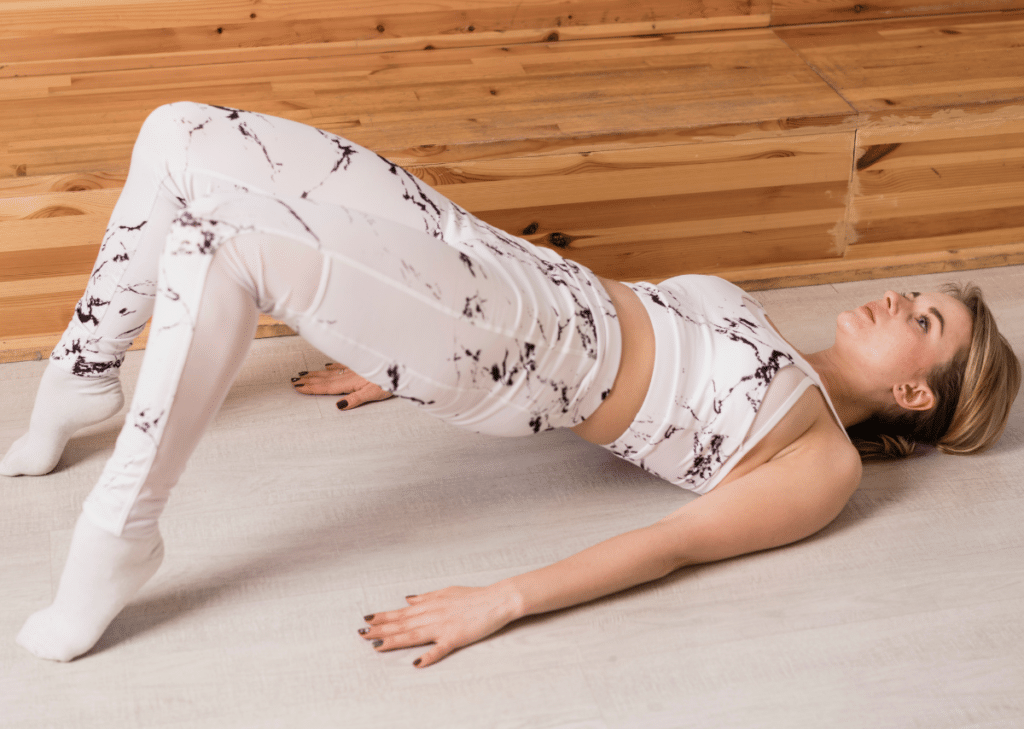
Glute Bridge
Backwards bending knees. Engage your core. Lift your hips upward.Firm your buttocks in the top. Do not arch your back lower back.Lower slowly. Perform 10–15 repetitions.
Sitting on the Wall with Engaging the Core
Stand against a wall. Slide in a squat position.Use your core without being too vigorous but in a neutral position. Hold for 20–30 seconds.This develops stamina without any overstrain of the abdomen.
Activities that should be avoided in the case of diastasis recti
Core workouts are not necessarily safe. Other movements augment intra-abdominal pressure.
Avoid:
• Traditional crunches
• Sit-ups
• Full planks (early stages)
• Leg raises
• The heavy lifting with no control of the core.
• Intense twisting exercises
Abdominal separation may be aggravated by these movements. Always give preference to controlled activation as opposed to intensity..
The Question of Diastasis Recti Frequency
Consistency is key.Start with 10–15 minutes per day. Do preparatory Diastasis Recti exercises 4-5 times/ week.Progress gradually. Healing is dependent on the severity, age, and health.The majority of the population reported an improvement in 8-12 weeks. Nevertheless, it may be slow in healing of the tissue.Listen to your body. No pain or apparent bulging.
The contribution of Posture and Lifestyle
Exercise alone is not enough. The everyday life is a factor that affects recovery.
Focus on:
• Sitting in a neutral position with the spine.
• No breath-holding at the lifting stage.
Grogger, roll me to your side, sit up.
• Treatment to stool and avoid straining.
• Promoting the wellbeing of the pelvic floor.
When posture is good it will lower the stress on the linea alba. Huge gains are achieved on the long term basis with minimal changes.
When to See a Specialist
Consult the professional in case your symptoms do not go away.
Consult:
• A physical therapist with a pelvic floor.
A postpartum rehabilitation specialist.
Sports medicine professional
<|human|>Sports medicine professional.
Severe cases may be subject to surgery. Nonetheless, with progressively planned exercises in diastasis recti, most of the people become better.
Early intervention has higher results.
Conclusion
Diastasis Recti exercises is common. But it is manageable.You are able to regain strength fundamentally. The only thing required is the right strategy. Attend to breathing, muscle deep engagement and progressive movement.High-pressure needs should be avoided. Stay consistent. Monitor your form.When you do the right diastasis recti exercises, you regain the stability, and posture and alleviate pain. Firm underpinnings bring about sustainable outcomes.Start today. It is under conscious movement that your core recovery starts.
FAQS:Frequently Asked Questions
1. The question is how long it takes to heal diastasis recti using exercises?
Majority of the individuals report improvement in 812 weeks. Severe cases may take longer. More important is consistency and correct form.
2. Is it possible to achieve the development of diastasis recti by men?
Yes. It can be acquired by men, either because of weight gain, inappropriate lifting, or overloading of abdominal pressure.
3. Should diastasis recti be subjected to surgery?
Surgery is rarely required. The majority of the cases are treated with the help of structured diastasis recti exercises and core rehabilitation.
4. Is it possible to perform cardio when having diastasis recti?
Yes, but of low impact ones. The exercise to be safe is walking and stationary cycling. Exercise should not include high-impact activities at the initial stages.
5. Do Waist trainers repair diastasis recti?
No. Connective tissue is not repaired with the aid of some outside. The best way is through specifically targeted core strengthening.